Since January 1, 2026, Louisiana sellers have been required to use a revised Property Disclosure Document, and the change that matters most in the Garden District has nothing to do with formatting. The Louisiana Real Estate Commission tightened the language that once let a seller point to an as-is clause and treat a previously repaired defect as settled business. For most of the state, that is a legal footnote. For a homeowner in Roseland Terrace, Drehr Place, or Kleinert Terrace preparing to sell a house built before 1930, it changes what the folder of old permits in the hall closet is actually worth.
Here is the mechanism. Before this year, the standard disclosure form hedged the seller's obligation with a parenthetical: the requirement to disclose known defects applied "despite any agreement to the contrary," but that phrase sat in parentheses, and parentheses invite argument. Sellers and their attorneys sometimes read that softness as room to negotiate the disclosure duty away in a side letter or an as-is addendum. The 2026 mandatory forms, effective statewide as of January 1, took the parentheses out. A known material defect must be disclosed. It cannot be waived by private agreement, and the seller's duty to update that disclosure continues right up until the act of sale, not just at the moment the form is signed.
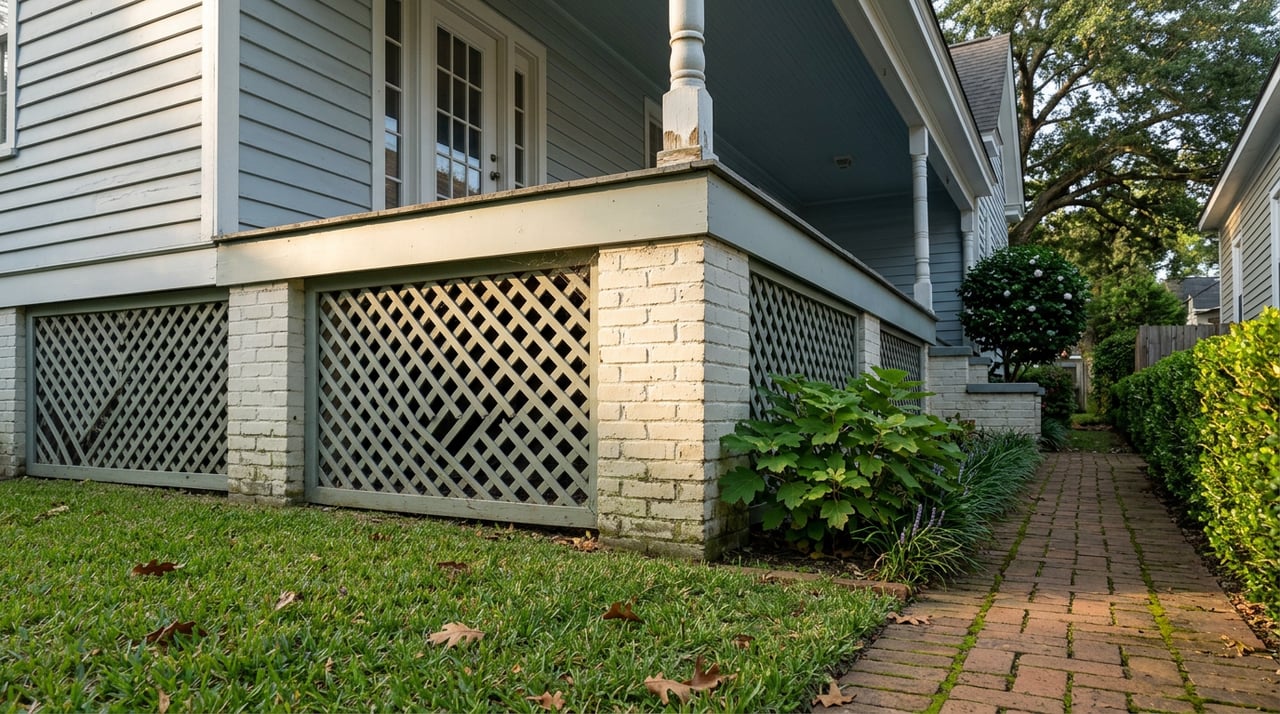
That single edit lands differently depending on what kind of house you own. A five-year-old slab home in a new subdivision rarely has much disclosure history to argue about. A century-old pier and beam house in the Garden District almost always does, because pier and beam construction was the standard response to Baton Rouge's expansive clay soils and periodic flooding long before slab foundations became common, and clay soil that swells and contracts does not stop moving just because someone leveled the piers a decade ago.
What "fixed" no longer means
Louisiana's disclosure statute has always defined a known defect narrowly. It has to be something the seller actually knew about, and it has to affect value, safety, or the home's expected life if left unaddressed. Full, professional repairs were never automatically exempt. What changed in 2026 is that the form no longer leaves an opening to argue the repair closed the question. If you replaced three rotted piers under the back bedroom eight years ago, that repair itself, along with the fact that the original condition existed, is the kind of history a buyer is now entitled to see documented, whether the work was flawless or not.
This is where most sellers get the story backward. They assume a completed repair is a liability to minimize. In the Garden District specifically, it is often the opposite, because the repair already has a paper trail sellers elsewhere have to reconstruct from memory.
The historic district did the paperwork for you
Roseland Terrace, Drehr Place, and Kleinert Terrace are not just old neighborhoods with a shared name. Each is a locally designated historic district under Baton Rouge's Unified Development Code, on top of its National Register listing, and that local designation carries a real obligation: any exterior change visible from a public street, from a new porch rail to a foundation repair that required disturbing the crawl space access, needs a Certificate of Appropriateness from the city's Historic Preservation Commission before work begins. Ordinary maintenance is exempt, but structural repair generally is not.
That means a foundation job done correctly in a locally designated district almost always generated a public record: an application describing the work, the date it was submitted, and the commission's approval. The Drehr Place design guidelines spell out exactly this review process, and the same structure governs Roseland Terrace and Kleinert Terrace as the three subdivisions that make up the Garden District. A seller who went through that process was not just complying with a preservation ordinance. They were building the exact documentation the new disclosure form now expects them to be able to produce.
That is the piece most Garden District sellers have not connected yet. The Certificate of Appropriateness file sitting with the Office of the Planning Commission is not a separate hoop from disclosure. Under the 2026 rules, it is closer to Exhibit A.
What changed, in plain terms
| Before January 1, 2026 | Since January 1, 2026 | |
|---|---|---|
| As-is language | Could be read as room to waive disclosure of a known, already-repaired defect | Explicitly cannot override the duty to disclose |
| Timing of the duty | Understood mainly as a point-in-time form | Continuous, through closing, if new information arises |
| Repaired defects | Ambiguous whether the original issue still needed mention | Still expected to be disclosed as part of the property's known history |
Real estate professionals tracking the rollout have described it as closing a "no loopholes" gap in how defects are handled at the point of sale, and the change applies to every residential seller in the state, not just historic properties. What makes it worth a longer look in the Garden District is the age and construction type of the housing stock itself. The neighborhood retains roughly 88 percent of the housing built there before 1930, according to the American Planning Association's profile of the district, and the oldest documented house in the neighborhood, the Reiley-Reeves house, dates to 1910 and has stayed with the same family since it was built. Houses that old have foundation stories. The question in 2026 is whether those stories are documented or whether the seller is relying on memory.
What this actually costs, and why the range matters
Pier and beam repair in the Baton Rouge area typically runs from roughly $1,000 to $3,000 per pier for straightforward replacement, with crawl space encapsulation running $5,000 to $15,000 depending on scope, and drainage corrections adding another $1,000 to $5,000 on top of that. None of those numbers are alarming on their own. What matters for a seller is that a repair in that range, done under a Certificate of Appropriateness a decade ago, is a very different conversation with a buyer than an undocumented repair a buyer's inspector discovers cold during due diligence. The first version reads as a maintained historic home. The second reads as a question mark, and question marks get priced into offers.
A repair that never went through the Historic Preservation Commission because it did not touch anything visible from the street is not a problem. But if the work involved the kind of structural access that would have required a COA and none was filed, that gap itself becomes something to think through before listing, not after an inspection raises it.
A few direct questions
Does an old Certificate of Appropriateness expire or need to be renewed to sell the house? No. A COA documents that specific approved work at the time it was done. It does not need renewal for a future sale, but it is worth pulling from the Planning Commission's files before you list, so it is in hand rather than something a buyer's attorney has to request.
If a repair was inspected and permitted at the time, do I still have to mention it on the disclosure form? Generally yes. Louisiana's disclosure standard is not whether the repair was done well. It is whether the seller has known information about the property's condition and history that a buyer would reasonably want. A well-documented, permitted repair is easier to disclose credibly than an undocumented one, but documentation does not erase the disclosure obligation itself.
What if the repair was done by a previous owner, not me? The disclosure duty runs to what you actually know, not what every past owner knew. If you were told about a prior foundation repair, if it shows up in the home's permit history, or if it is visually apparent, that generally counts as something within your knowledge to disclose.
How long does a buyer have to raise an issue after closing? Louisiana's redhibition framework generally gives a buyer up to one year to bring a claim over an undisclosed defect discovered after the sale, which is part of why a clean, dated paper trail matters more now than it did under the older form language.
Selling a house that has been in a family for decades, in a neighborhood with its own preservation commission and its own paperwork trail, is not a transaction to handle from a template. Del Rio Real Estate has built its practice around Baton Rouge's distinctive legacy properties and understands how the city's permitting record and the state's disclosure form now work together rather than as two separate hurdles. If you are weighing a sale of a Garden District home this year, schedule a private consultation and we will walk through what your specific repair and permit history means under the current rules before a buyer's inspector finds it first.